News
Cheaper international subscriptions with a digital wallet in Argentina
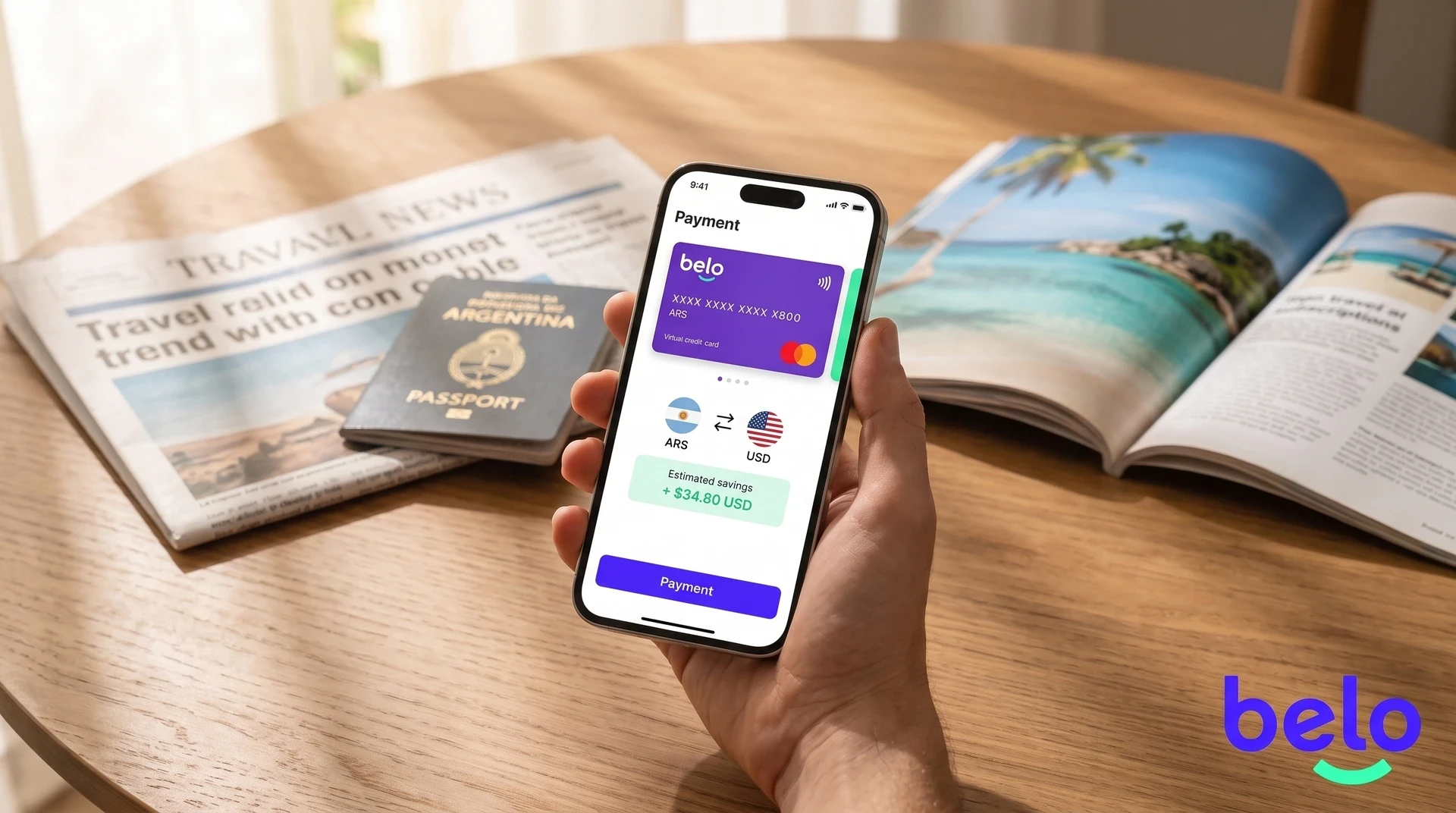
Paying for international subscriptions with an Argentine bank card means paying significantly more than the advertised price, due to the tax perceptions and the exchange rate applied at the closing of the statement.
Here we tell you why this happens and how a virtual dollar card can narrow that gap.
Download the belo app and check how to order your LUX card according to your account and current terms.
The surcharge nobody chose to pay
Every time an Argentine user pays for an international subscription with a bank credit card, the amount that appears on the statement can exceed the advertised service price by more than 60%.
A USD 20 monthly subscription to Gemini, ChatGPT Pro, or Claude can end up costing much more in pesos, depending on the tax perceptions and exchange rates in effect at the closing date.
This difference comes from a combination of AFIP tax perceptions (Income and Personal Assets tax) and the exchange rate applied when settling the transaction.
The problem has two layers. The first is fiscal, because the perceptions are calculated on the peso amount at the official exchange rate and represent a tax advance that in many cases can be claimed back, though the process takes months.
The second is exchange-related, as the exchange rate is determined on the closing date of the monthly statement and not at the time of purchase, which adds uncertainty to the final cost.
Multiply that by twelve months and add the three or four subscriptions that an average professional uses: an AI tool, music streaming, cloud storage, and some design or productivity service.
The annual overcost can be equivalent to paying several extra months of subscriptions to the clearing system.
Why a virtual dollar card changes the equation
Perceptions and deferred exchange rates apply when the payment goes through the Argentine banking circuit.
A credit card issued in the country settles international purchases in pesos at the closing of the statement, and that is where the surcharges kick in.
The mechanism is designed for transactions processed as foreign currency consumption through entities regulated by the BCRA (Central Bank of Argentina). A virtual card issued outside of this circuit operates under a different logic.
The user loads a dollar balance (or an equivalent stablecoin) into a digital wallet, runs a virtual card associated with that balance, and pays directly in the currency of the service.
Since the debit occurs instantly against a balance that is already in dollars, there is no subsequent conversion or perceptions applied to the purchase. The difference shows in the numbers.
If you take a USD 20 subscription and pay with an Argentine bank card, the current Income and Personal Assets perceptions on the amount converted to pesos at the official exchange rate are added to the original price, along with the uncertainty of that exchange rate.
These percentages change with local regulations, so it is best to verify them before paying.
With a virtual dollar card to pay for ChatGPT, Gemini, or Claude, you pay exactly the advertised price, plus any conversion fee applied by the wallet if you loaded your balance in another currency.
Cost comparison by payment method
Payment method · Applied perceptions · Real cost on USD 20
Argentine bank card · Income and Personal Assets perceptions on the official exchange rate (percentages in effect at the time of payment) · Significantly more than USD 20 equivalent
Virtual dollar card · No perceptions, only conversion fee if applicable · USD 20 plus wallet fee
From download to the first payment
There are four key moments in the process, each with its own times and requirements.
The four moments of the process
Identity verification (KYC) is the step that can take the longest. International digital wallets require ID, a selfie, and in some cases, proof of address.
In apps like belo, which offers a virtual Visa card called LUX specifically designed for international payments and subscriptions, verification is done from your cell phone and is usually resolved in minutes. Once identity is approved, services are enabled.Loading a dollar balance is the second key step. Depending on the wallet, you can receive ACH transfers from accounts abroad, convert funds with the app, or transfer from other platforms. The important thing is that the balance must be available in dollars before generating the card and linking it to the service you want to pay for.
Generating the virtual card takes seconds from the app. What you get is a card number, expiration date, and security code that you can use on any site that accepts Visa. You can also link it to Apple Pay or Google Pay to keep it handy.
Once generated, go to the payment settings of Gemini, ChatGPT, Claude, or Spotify, replace the current payment method with the virtual card, and confirm.Checking after the first charge is the step many forget. It is wise to verify that the debited amount matches the advertised price of the service and that there are no unexpected additional charges.
This check, which with a bank card you could only do weeks later when the statement closed, is available instantly on this app.
What you should know before starting
The most frequent question is whether this is legal. Paying for an international subscription with a virtual dollar card from a digital wallet is a valid operation.
Perceptions are an advance tax collection mechanism that applies to transactions processed by Argentine financial entities, and using a payment method that operates outside of that circuit does not constitute tax evasion.
If you have already paid perceptions with a bank card in previous periods, you can request a tax refund from AFIP by submitting the corresponding form in your Income Tax return, although the reimbursement may take time.
Operational risks to consider
If the wallet experiences a technical issue on the day your subscription renews and there is no sufficient balance, the payment will fail and the service will be suspended. Keeping a balance slightly higher than the subscription amount is the simplest way to avoid interruptions.
The conditions of these platforms can change, both in terms of fees and available features for each country, so it is recommended to review the terms periodically.
This method works for virtually any international subscription that accepts Visa or Mastercard, from AI tools to streaming, storage, and productivity services.
What changes the equation is not the service you pay for but the channel through which the payment is routed.
Frequently asked questions about cheaper international subscriptions with digital wallets in Argentina
Can I recover the tax perceptions I already paid with my bank card?
Yes. Income and Personal Assets Tax perceptions are tax advances that can be declared in the annual tax filing with AFIP. If the perceived amount exceeds your tax liability, you can request a refund, although the reimbursement may take several months to go through.
To initiate the process, you must submit the corresponding form at the time of making your annual declaration. It is advisable to keep your card statements as supporting documentation for the period in question.
What happens if the digital wallet closes or changes its conditions?
In that case, you would need to update the payment method in each affected service before the next billing date. To reduce this risk, it is best to choose established platforms and periodically verify that conditions have not changed significantly.
It is also useful to have an alternative payment method configured for your most critical services to prevent an unexpected interruption in access.
Does this method work for debit cards or only for virtual credit?
The virtual cards issued by international digital wallets generally work as prepaid cards, where the debit is instantly made against the balance available in the app. They do not require or simulate a traditional bank credit line.
This means you can only spend what you have already loaded, which also makes managing your active subscriptions more predictable.
Does the PAIS tax apply to payments made with virtual dollar cards?
The PAIS tax applies to transactions routed through the foreign exchange market regulated by the BCRA. Payments made from international digital wallets using a dollar balance fall outside of that circuit, so this tax does not apply, although regulatory conditions can vary over time.
It is advisable to follow regulatory changes regularly, as the tax framework for digital transactions in Argentina has undergone modifications in recent years.
How much balance is recommended to keep in the wallet to avoid automatic renewal issues?
A reasonable practice is to keep at least the equivalent of two billing cycles for your active subscriptions. This provides a safety margin in case of any delay in a transfer or minor variation in the amount billed by the service.
If you have several subscriptions that renew on different dates, reviewing your payment calendar once a month is sufficient to keep your balance in order.


