News
How to save in dollars in Argentina without a fixed-term deposit (with USDT and USDC)
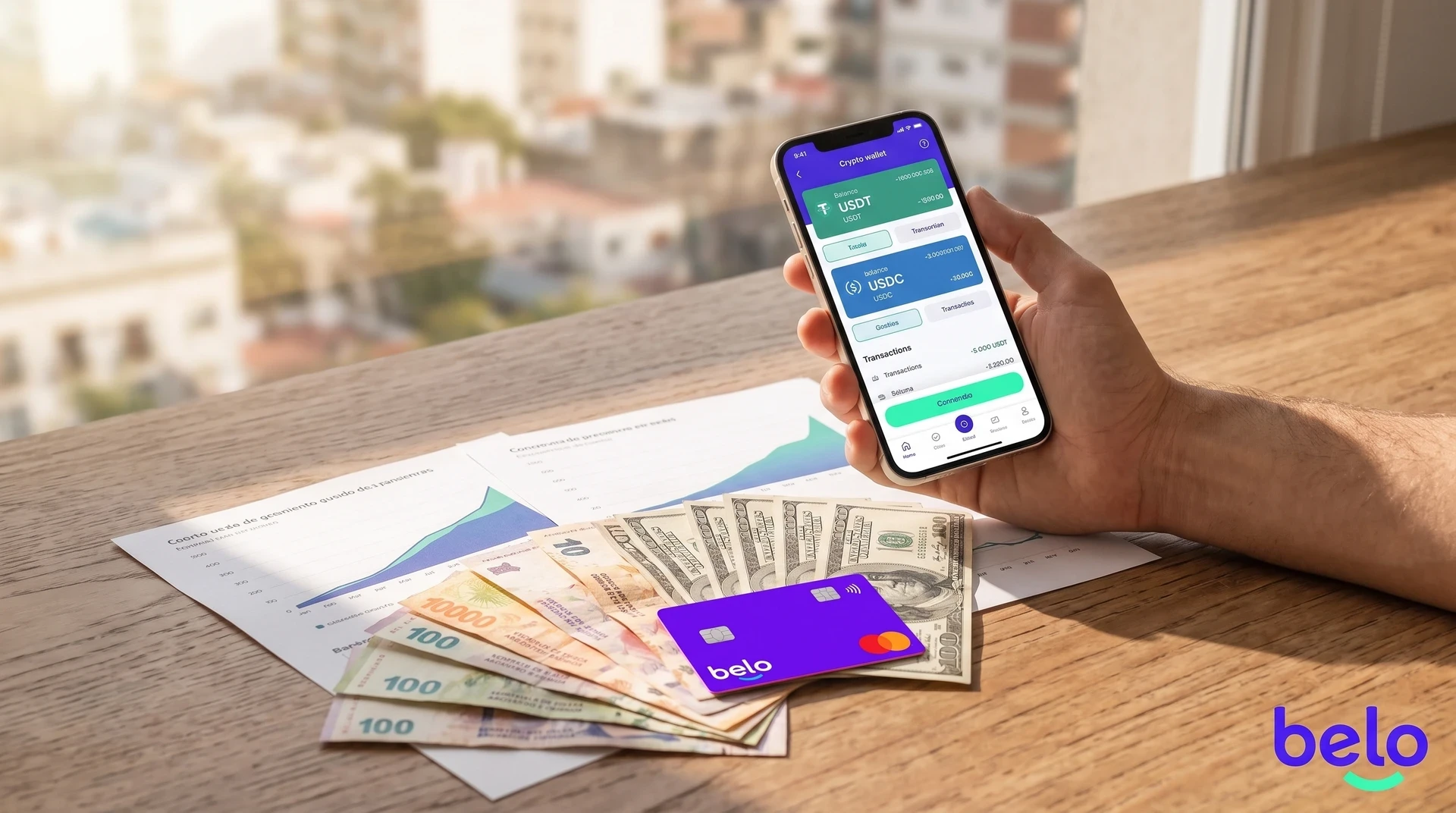
Saving in dollars in Argentina usually means choosing between the mattress, a fixed-term deposit, or a bank account, and none of those options adequately solve the problem of having availability and preserving value at the same time.
Here we tell you how stablecoins work as an alternative, what differences they have from each other, and what to check before getting started.
Download the belo app and check what options you have available to save in stablecoins according to your account and current terms and conditions.
The cost of not deciding
An Argentine who kept 1,000 dollars under the mattress in January 2023 still has exactly 1,000 dollars. Meanwhile, inflation in the United States has been eroding part of that purchasing power without anyone warning.
At the other extreme, whoever left the equivalent in a fixed-term deposit in pesos had to wait 30 days to access it, with no guarantee that the rate would beat devaluation.
The two most popular saving options in Argentina share a problem that is rarely discussed: they force you to choose between availability and preservation of value.
Stablecoins, known as digital dollars, changed that equation for thousands of people looking to save in dollars without relying on the traditional banking system.
USDT (Tether) and USDC (USD Coin) are crypto assets designed to maintain a 1:1 parity with the US dollar, which means that one USDT or one USDC is always equivalent to one dollar.
Unlike bitcoin or ethereum, these currencies do not fluctuate with the volatility of the crypto market because they are backed by reserves in dollars, Treasury bonds, and other liquid assets.
That makes them a savings vehicle with a concrete advantage over physical bills and the fixed-term deposit: you can move, convert, and use them at any time, with no banking hour restrictions.
What do you buy when you buy USDT or USDC?
Although both trade at one dollar, USDT and USDC have differences that matter when the goal is to store savings.
USDC, issued by Circle, publishes monthly audits of its reserves through recognized accounting firms, offering greater transparency about what backs each token.
USDT, issued by Tether, has the highest liquidity in the crypto market and is available on virtually all platforms, although it has historically faced questions regarding the exact composition of its reserves.
USDT vs. USDC: key differences for the saver
Feature · USDT (Tether) · USDC (Circle)
Liquidity on exchanges · The highest in the market, with lower spreads on most platforms · High, though with lower daily volume than USDT
Transparency of reserves · Historically questioned due to lack of detail on its composition · Monthly audits published by recognized accounting firms
Platform availability · Present on virtually all exchanges · Broad, though with lower coverage than USDT in emerging markets
Depegging history · No major episodes recorded · Brief depegging in March 2023 following the collapse of Silicon Valley Bank, resolved in under 48 hours
The answer depends on what those digital dollars will be used for. For someone looking to buy and sell quickly, USDT offers lower spreads on most exchanges because it has more active buyers and sellers at all times.
For those who prioritize certainty regarding backing, USDC has an advantage in transparency.
Both have consistently maintained their parity with the dollar, with one notable exception in March 2023 when USDC briefly depegged following the collapse of Silicon Valley Bank, an event that was resolved in less than 48 hours.
Diversifying between both stablecoins reduces the risk of exposure to a single issuer.
Custody is the other decision that defines the experience. Leaving digital dollars on an exchange means trusting the security of that platform, with the advantage of being able to trade instantly.
Moving them to a personal wallet gives more control but requires greater responsibility, because losing that key means losing access forever.
How to convert pesos into digital dollars?
The flow to start saving in stablecoins has fewer steps than many imagine. Think of someone who earns their salary in pesos and wants to set aside the equivalent of 100 dollars every month.
Steps to convert pesos into stablecoins
Deposit Argentine pesos into a virtual wallet or exchange via bank transfer.
Convert pesos to USDT or USDC at the exchange rate shown on the screen by the platform before confirming the operation.
The funds are immediately available, with no waiting periods or hourly restrictions.
That is the basic scenario.
In belo, for example, you can set up automatic purchases of stablecoins with the frequency you prefer (daily, weekly, or monthly), define the exact amount, and pause or cancel at any time.
A weekly purchase of 25 dollars in stablecoins accumulates around 1,300 dollars a year without you having to remember to do it each time.
The funds are instantly available to use, whether to pay for international services, transfer abroad, or convert back to pesos when the exchange rate is favorable.
Frequent use cases
Having 500 USDC in a virtual wallet allows you to pay with a prepaid card abroad, with the amount defined at the time of payment and without depending on the closing of the statement.
An emergency fund saved in stablecoins is available 24 hours a day, 365 days a year, something no bank offers with a dollar account.
Before choosing a platform, it is advisable to compare the spread (the difference between the buying and selling price) because it can vary between 0.5% and 2% depending on the exchange, and that accumulated difference in several operations eats into part of the savings.
What can go wrong and how to prepare?
Saving in stablecoins has risks that are worth measuring before moving the first peso.
Regulatory risk in Argentina is real: the CNV and the BCRA can modify the rules regarding crypto asset operations, and since 2025 supervision of platforms offering products linked to virtual assets has intensified.
This does not prevent trading with stablecoins, but it is advisable to choose platforms that comply with current regulations and keep a record of transactions in case the AFIP requires documentation.
Security best practices
Enabling two-factor authentication (2FA) with an app like Google Authenticator instead of SMS drastically reduces the possibility of someone accessing your account.
Never share your seed phrase or wallet recovery key, as anyone who has that key has full access to the funds.
Always verify addresses before transferring crypto, because an incorrect address results in irreversible loss.
Be wary of messages promising guaranteed returns, a common sign of fraud in the crypto ecosystem.
Do not concentrate 100% of your savings in a single stablecoin or on a single platform, because the diversification that works in traditional finance applies exactly the same way in the digital world.
The risk of a peg depegging, although statistically low, exists. The best protection is to distribute savings among different stablecoins and platforms.
Frequently asked questions on how to save in dollars in Argentina without a fixed-term deposit
Is it legal to buy USDT or USDC in Argentina?
Trading stablecoins is legal in Argentina. The CNV and the BCRA regulate platforms offering this type of asset, so it is advisable to use exchanges that are registered and comply with current regulations.
Keeping a record of transactions is good practice, especially in case the AFIP requests documentation at some point.
What happens if the platform where I hold my stablecoins goes bankrupt?
If the funds are on an exchange and the platform goes bankrupt, access to those funds may be compromised, unlike a personal wallet where the user controls their own keys. Distributing savings between your own wallet and an exchange reduces that risk.
There is no deposit insurance for crypto assets in Argentina equivalent to that of banks, so self-custody is the most concrete protection available today.
What is the minimum amount of money needed to start saving in stablecoins?
Most platforms do not have a mandatory minimum to buy stablecoins, so you can start with small amounts. It is advisable to check if the platform applies flat fees that would make operating with very low amounts inefficient.
On belo, for example, you can start with the amount you have available and set up automatic purchases to accumulate gradually.
Do stablecoins generate any yield on their own?
Stablecoins on their own do not generate yield, as they are designed to maintain their value around a dollar. Some platforms offer staking or lending products that pay interest on deposited stablecoins, but those products entail additional risks that must be evaluated separately.
If the goal is to preserve value without taking on extra risk, holding stablecoins without additional products is the most straightforward option.


