News
Where to safely store US dollars in Argentina and earn a yield
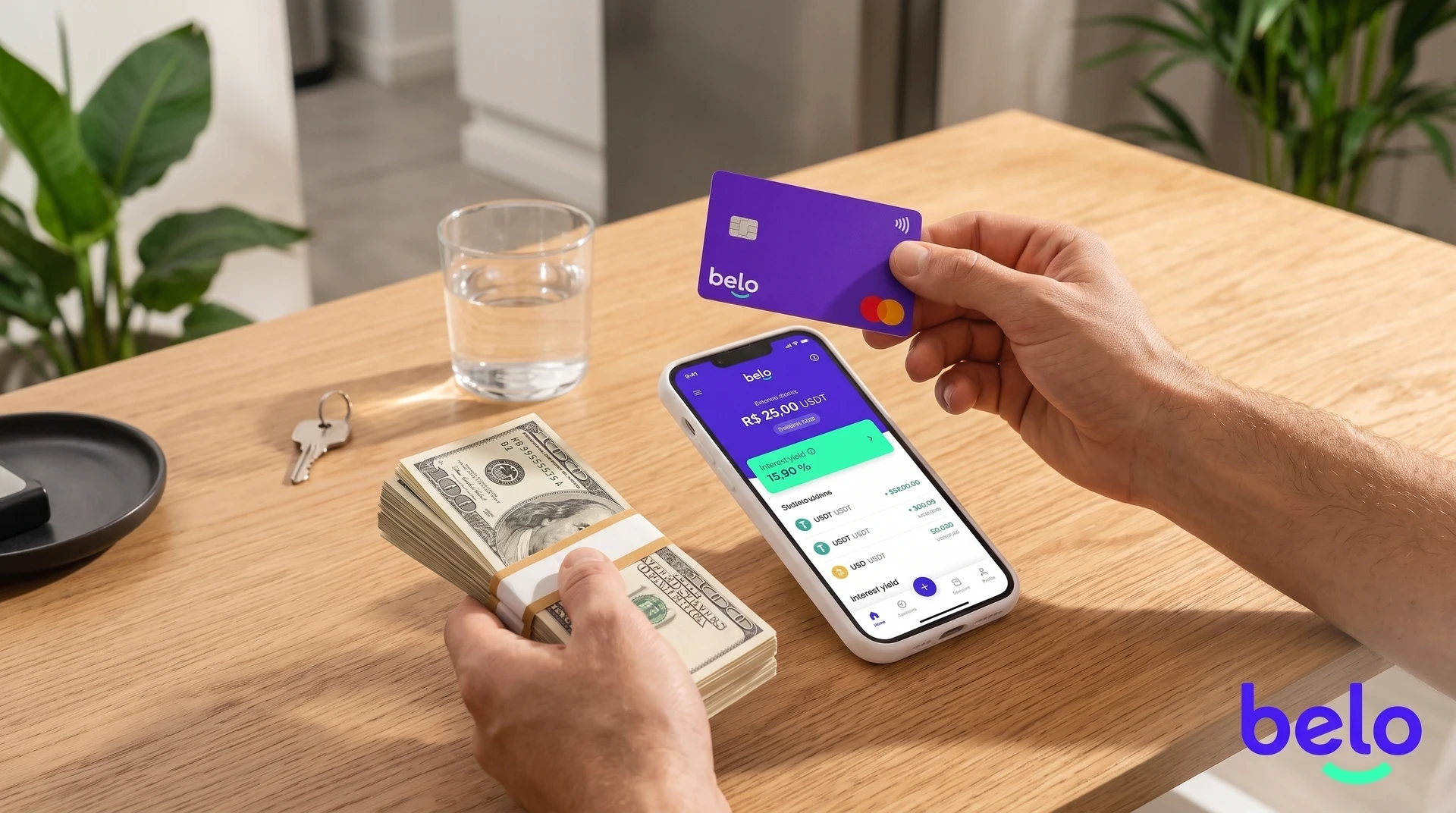
Saving dollars in Argentina means thinking about more than just where to put them: you have to decide between availability, security, and yield, knowing that improving one variable almost always costs something in another.
Here we review the most widely used options (cash, bank, and stablecoins) so you can choose according to your goal.
Download the belo app and check what options you have available to save dollars according to your account and current terms.
The invisible cost of saving dollars
A hundred-dollar bill kept in a drawer loses purchasing power every year.
Inflation in the United States erodes the value of that paper even if nobody touches it, but that fact almost never enters the equation when someone in Argentina decides where to keep their dollars safely, because the real urgency is different: that they are not stolen from you, that they are not frozen, and that they are available when you need them.
You can review the options to receive dollars according to your situation and current conditions.
Cash at home solves immediate availability, but it opens up two fronts that many play down.
The first is physical risk, from robbery to deterioration due to humidity or fire, which no home insurance covers in foreign currency.
The second is the temptation to spend them: without an access barrier, "reserve" dollars end up financing current expenses. Anyone keeping cash chooses total liquidity in exchange for zero protection and zero yield.
The bank seems like the safe option, and under normal conditions, it is. A savings account in dollars protects against theft and allows unlimited accumulation.
But Argentine history has taught that "normal conditions" is a fragile category: the 2001 "corralito", the exchange restrictions that were repeated in different forms, and the clearing times that can take days are real costs that do not appear in the fine print.
Having dollars in the bank means trusting that the rules are not going to change, and that trust has a price that each person measures differently according to their experience.
Stablecoins, the third way
Stablecoins like USDT and USDC maintain a 1:1 parity with the US dollar. They work on blockchain networks, which means they can be sent, received, and held without relying on a bank or business hours.
That independence made them the preferred tool for freelancers and savers operating internationally from Argentina.
Buying stablecoins today requires fewer steps than opening a fixed term deposit. From any digital wallet that operates with crypto-assets, you can exchange pesos for USDT or USDC in minutes, with the exchange rate visible before confirming.
Custody, on the other hand, requires a more thoughtful decision. If you leave your stablecoins on a platform (custodial), security depends on that company.
If you move them to your own wallet (individual custody), security depends entirely on how you manage your access. Each model has its counterparty risk, and understanding the difference is what separates those who use stablecoins wisely from those who expose themselves without knowing.
What to keep in mind according to the type of custody
For custodial storage, the minimum is to activate two-factor authentication (2FA) and verify that the platform has a verifiable history of operations.
For individual custody, a cold wallet offers the highest level of protection for keeping digital dollars, though it requires keeping the seed phrase in a safe place away from any digital device.
Losing that seed phrase is equivalent to losing the funds, with no option for recovery.
How stablecoins compare to other options
Feature · Cash at home · Bank · Stablecoins
Availability · Immediate · Limited during crises · 24/7, no holidays
Security · Physical and theft risk · High under normal conditions · Method of custody dependent
Portability · Limited by physical nature · Slow transfers with fees · Movement between countries in minutes
Yield · None · Very low or none · Variable according to platform
When each option is best
There is no abstract "best way" to keep dollars in Argentina. It depends on what you are going to use them for and in how much time.
If you travel frequently, you need your dollars to be available instantly and to be able to convert them to the destination's local currency without going through an exchange house.
Stablecoins can facilitate this scenario because they allow paying or converting from the phone, at an exchange rate defined at the moment of the transaction.
In belo, funds in USDC or USDT can be used for international payments or converted to pesos when needed, all within the same app, although costs and conditions may vary depending on the type of operation.
For programmed saving, where the goal is to accumulate dollars month by month without touching them, savings jars in USDT or USDC work like a digital envelope that separates money from daily cash flow.
The advantage over a physical envelope is that access requires a deliberate action (entering the app, confirming the withdrawal), which reduces the risk of impulse spending.
Unlike a fixed term deposit in dollars, there is no minimum holding period or penalty for withdrawing early.
For remittances, when you need to send dollars to another country or receive them from abroad, stablecoins can reduce the number of banking intermediaries involved in the operation.
A transfer in USDC is usually credited in minutes, and the network fee can turn out to be lower than that of a traditional bank transfer, although this depends on the network used and the current conditions in each case.
The three variables that define your decision
Security, availability, and yield work like a triangle where improving one variable usually compromises another. Cash at home maximizes availability but sacrifices security and yield.
The bank maximizes perceived security but can limit availability in crisis contexts. Stablecoins offer a balance among the three, but require the person to assume the responsibility of their own custody or choose well whom to delegate it to.
What changed in recent years is that keeping dollars in digital format stopped being a technical decision reserved for early adopters.
Today anyone with a phone can open an account in a virtual wallet, buy USDT or USDC and have their dollars available without safe deposit boxes, without banking hours, and without relying on the rules of the financial system to remain stable.
The relevant question is no longer whether it makes sense to consider stablecoins as an alternative, but how much of your dollar reserve makes sense to keep in each format according to your usage profile and risk tolerance.
Frequently asked questions about where to save dollars safely and with yield in Argentina
Are stablecoins like USDT and USDC really equivalent to the dollar?
They maintain a 1:1 parity with the US dollar backed by reserves of their issuers, although that backing does not have the guarantee of a central bank. In practice, both are widely used as digital equivalents of the dollar for savings and everyday transactions.
What happens if the platform where I hold my stablecoins goes bankrupt?
If your funds are in custodial storage and the platform goes bankrupt, recovery depends on the legal processes of that company, which can take time or result in partial losses. Moving funds to your own wallet eliminates that counterparty risk, although it transfers security responsibility entirely to the user.
Is it advisable to have all dollars in a single format?
Concentrating all savings in a single format exposes to specific risks of that model, whether it is physical theft, bank restrictions, or vulnerabilities of a platform. Distributing between cash, bank, and stablecoins according to the intended use of each portion reduces total exposure.
How much does it cost to send dollars abroad with stablecoins compared to a bank?
An international bank transfer via SWIFT usually involves commissions and a clearing time of several business days, although the exact cost varies by bank and country. A transfer in USDC or USDT can be credited in minutes, with a network fee that is usually lower, although it also varies depending on the network used.
Do I need technical knowledge to start using stablecoins?
For custodial storage on a digital wallet like belo, the process is similar to opening any financial account from the phone. The learning curve increases when opting for individual custody with a cold wallet, where managing the seed phrase requires more attention and judgment.


