News
How to save money as a freelancer or digital nomad (even if your income fluctuates)
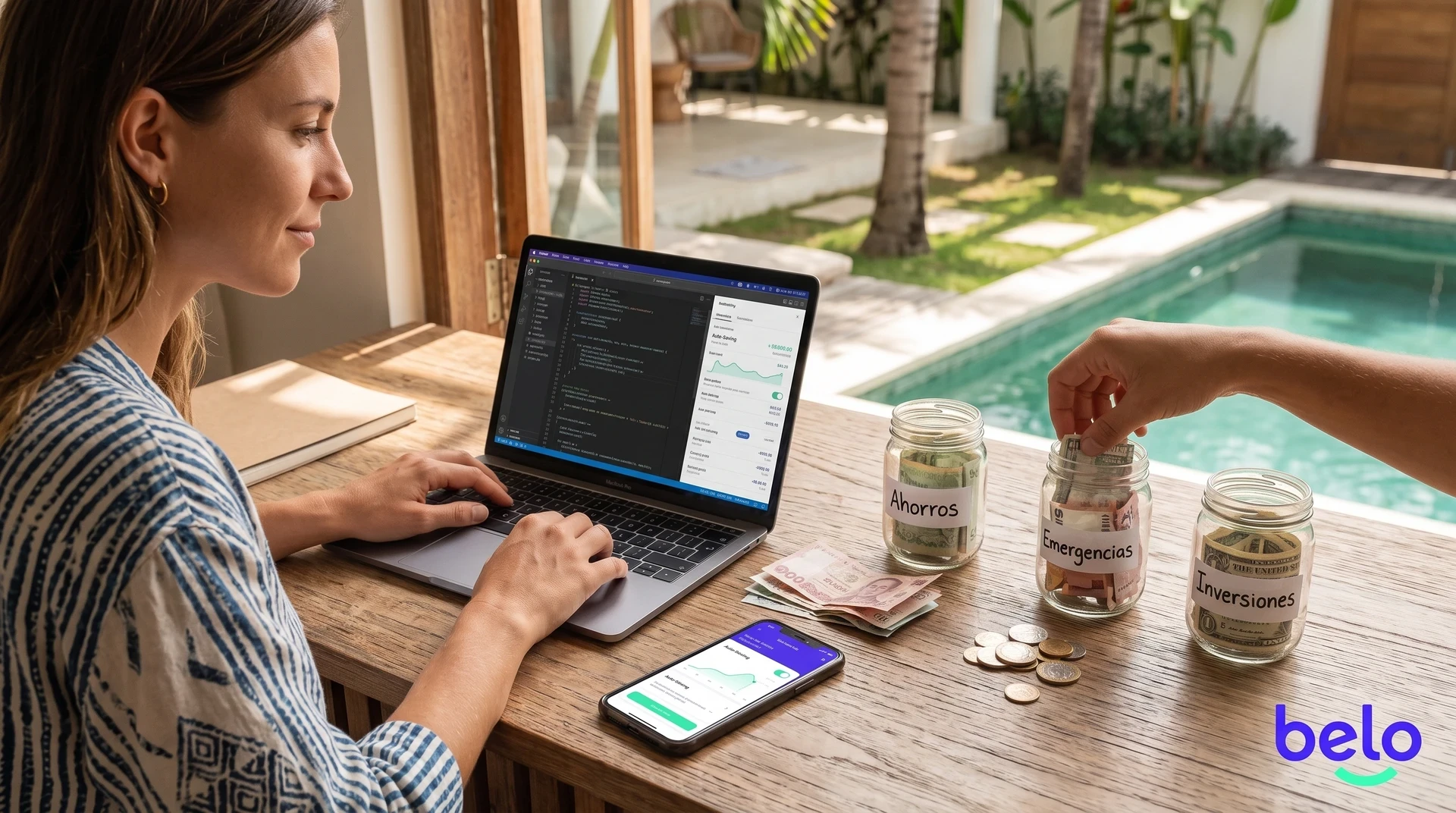
When your income changes every month, saving consistently becomes harder than it is for someone with a fixed salary.
This guide explains how to calculate a baseline income, allocate each payout among expenses, an emergency fund, and goals, and automate the process so it does not depend on memory.
Download the belo app and review the options available to automate your savings according to your account and current terms.
The number your bank account does not show you
A freelance designer earns USD 3,200 in March, USD 800 in April, and USD 2,400 in May. If they spend as if they earned 3,200 every month, they have a problem in April.
If they spend as if they earned 800, they miss a real opportunity to build a cushion in March. Most freelancers and digital nomads swing between those two extremes without a clear criterion, and that costs them more than any bank fee.
The first step to saving as a freelancer is to stop thinking about what you earn each month and start operating with a fixed baseline figure.
That figure is calculated by taking the last six months of income, discarding the highest and lowest, and averaging the remaining four.
If during that period you earned USD 3,200, 800, 2,400, 1,600, 2,000, and 1,200, you discard the 3,200 and the 800, and the average of the remaining four gives you USD 1,800. That is your operational base income, the figure upon which you will build your entire system.
Why discard the extremes? Because exceptional months, both good and bad, distort your perception.
The operational base income gives you a conservative but realistic baseline, and everything that comes in above that line becomes fuel for your emergency fund or your savings goals.
How to calculate your operational base income
Gather your income from the last six months of work
Identify the month with the highest pay and the month with the lowest pay, and discard them
Average the remaining four months to get your operational base income
Use that figure as a fixed baseline for all your allocation decisions
Three destinations for every dollar that comes in
With your base income defined, you need an allocation that works even when the amounts change. The logic is to divide each payout into three destinations with percentages that adjust based on the relationship between what you received and your operational base income.
When a payout falls below the base income, the priority is liquidity. An allocation of 70% for expenses, 20% for the emergency fund, and 10% for savings goals maintains the structure without suffocating you.
When the payout exceeds the base income, operational expenses are already covered by the 70% of the base, so the surplus can go 60% to the emergency fund and 40% to goals, accelerating both objectives without affecting your standard of living.
Allocation by type of payout
Payout situation · Operational expenses · Emergency fund · Savings goals
Payout below base income · 70% · 20% · 10%
Surplus above base income · 0% (already covered) · 60% · 40%
The logic is clearer when looking at two different profiles of variable income.
Someone who gets paid by project, with unpredictable months, needs to react payout by payout: every time a payment comes in above the base income, that surplus strengthens the emergency fund and goals in the corresponding proportion.
Someone with a recognizable high season (for example, more work towards the end of the year) can plan by blocks, accumulating during strong months to support thin ones without having to touch their standard of living.
The developer needs to react month to month because their income is unpredictable. Those with seasonality can plan by blocks because they know when the high season arrives.
The system works the same for both because the logic of adjustable percentages absorbs variance without requiring new decisions every time a payment comes in.
Automate before you think
The percentage system has a natural enemy, which is the temptation to "do it later" when money falls into a single account. The allocation must happen at the moment of payout, before the total amount gets mixed with day-to-day expenses.
If you receive payments in dollars or other currencies from abroad, you need a tool that allows you to separate funds automatically without depending on a traditional bank that forces you to convert everything to local currency at the least convenient moment.
In belo, you can set up automatic savings by choosing the exact amount, the currency (dollars, stablecoins, or pesos), and the frequency (daily, weekly, or monthly), and pause or edit it at any time from the app.
Each foreign payout is distributed to your three destinations without you having to remember it or make decisions with the recently received money.
The decision of when to convert foreign currency also matters for freelancer savings. If your fixed expenses are in local currency but you get paid in dollars, convert only what is necessary to cover the 70% operational and keep the rest in the original currency.
Converting everything at once exposes you to an exchange rate that might not be the best, while converting in parts allows you to take advantage of more favorable timings.
What to measure to know if it's working
A system without metrics is a system you abandon in three months. There are three numbers you should review every quarter.
The first is the coverage of your emergency fund, measured in months of covered operational expenses.
If your base monthly expense is USD 1,400 and your fund has USD 4,200, you have three months of coverage. The minimum goal for irregular incomes is to cover four months because irregularity can group two or three slow months in a row.
The second is the effective savings percentage over total income for the quarter. Any value above 15% in a quarter with irregular months indicates that the system is working.
The third is the income variation between quarters, which shows you whether your irregularity is widening or stabilizing.
If the difference between your best and worst quarter exceeds 60%, it is advisable to increase the percentage allocated to the emergency fund from the surplus to 70% until reaching five months of coverage.
Signals to adjust the system
If your emergency fund drops below two months of coverage, temporarily redirect the goals percentage to the fund
If three consecutive months fall below the base income, reduce the total savings percentage to 20% until it stabilizes
If your fund exceeds five months of coverage, you can redirect the entire surplus to savings goals or more ambitious objectives
The most concrete step you can take today is to calculate your operational base income with the last six months of payouts and set up an automatic transfer with the first percentage allocation.
You do not need the perfect system from day one; you need a system that starts working before the next payout arrives.
Frequently asked questions about saving as a freelancer or digital nomad
What do I do if I have been working independently for less than six months?
Use the available months and apply a more conservative criterion: discard the highest month and calculate the average of the remaining ones without discarding the lowest. This gives you a more prudent baseline while you build up enough history.
Can I apply this system if I get paid in pesos and not dollars?
Yes, because the logic of percentages works with any currency. The only difference is that in high-inflation contexts, it is advisable to review the operational base income more frequently, every two or three months instead of every quarter.
How many accounts do I need to separate the three destinations?
There is no fixed number, but having at least two helps ensure your emergency fund does not get mixed with day-to-day expenses. Tools that allow you to separate funds or schedule automatic savings within the same platform simplify this process.
What happens if I don't receive any payment in a month?
That is exactly the scenario for which the emergency fund exists. If the fund covers at least four months of operational expenses, a month with no income does not require any immediate adjustment. If the lack of payouts persists, then apply the signal to reduce total savings to 20% until income levels stabilize.


